When you think of deer, do you think of a doe feeding in a wilderness meadow, the Disney movie Bambi, or of the light-up decorations that were on display over Christmastime in front yards across Canada? For many people, deer are just that—something far away, a cartoon, or merely an inanimate decoration. However, in some cities in British Columbia, deer are a common, yet divisive, part of the urban landscape.
A Columbia black-tailed deer buck.
The native Columbia black-tailed deer (CBTD; a more docile sub-species of the mule deer found on the mainland), has coexisted on the landscape with humans for millennia. The First Nations of southern Vancouver Island used fire for land management that promoted the growth of important food plants like camas and would attract game species like CBTD. However, in the years since European colonization, southern Vancouver Island has grown into 13 municipal districts with a population of over 400,000 people. With the ensuing urban development, suburban sprawl, fire suppression, and predator exclusion has combined to change ecosystem dynamics and species distributions.
Coexistence with humans has resulted in habitat fragmentation, with a whopping 1,807 species at risk of extinction in BC, and over 110 of those species in southern Vancouver Island alone. However, some species do well coexisting with humans, like raccoons and deer—which can interact with humans and their property often enough to be considered nuisances. But are these now urban wildlife too numerous and running amok amidst the city backdrop, or is this actually bad press?
Just where are the deer?
The District of Oak Bay has been in the news often about a deer overpopulation problem. They’ve attempted a cull to manage deer populations, but as found in other municipalities, the cull had no lasting impact on the deer population but it did garner a public outcry. Management of the urban deer population has been highly polarizing—some people want them to stay, some people want them completely gone—but the management of urban wildlife is predicated on the knowledge of population size.
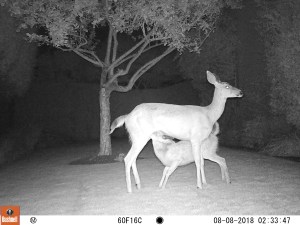
Even deer need to do 2:30 am feedings.
Residents
can give wildly different estimates of the number of deer present in Oak Bay. Any
single human observer may see six deer in their yard one day and then none the
next—humans have a cognitive bias, the availability bias, whereby we note large groups without noting
all the absences in between—which inflates estimates. And, when trying to count
mobile species, you need to be sure that you’re not counting the same
individuals more than once. And if you don’t see a deer, can you be sure that
it’s actually not there as opposed to just hiding? Thankfully camera traps to
the rescue!
Camera traps
Remote camera trap set up.
We divided the 10.5 km2 of Oak Bay into 400m grid cells, and we systematically placed one camera trap into each of those 39 grid cells. Each camera trap was a Bushnell infra-red remote digital camera, secured to a tree between 0.5-1.5 m above the ground. Human observers can miss deer that are well hidden or might miss them in time (e.g. once the observer goes home for the day). The motion-activated camera traps are able to take photos throughout the day, eliminating those kinds of errors. The systematic design we used also allows us to differentiate between areas with high numbers of deer and those without deer—and ensured we could collect multiple observations of the same individuals across space—allowing us to get a good idea of space use. In addition to the cameras, we put GPS collars on 20 does to get an idea of home range size in Oak Bay, but the GPS collars had double-duty, to “mark” our known deer population. By measuring how frequently we detected marked (collared) animals at a camera station, compared to the number of unmarked animals, we could get an accurate estimate of population size.
Attaching the GPS collar, which “marks” our deer on our camera trap photos. Each doe has a unique colour combination of tags that identifies each individual.
Combining this systematic camera trap design with GPS collars has allowed us to generate the first, precise and robust estimate of CBTD population size in Oak Bay’s history. So then, just how many deer are running rampant around Oak Bay? Our analyses tell us that there are just under 100 deer (97 is the median, 95% confidence intervals between 72-128) and that they aren’t distributed equally across the municipality. Most deer spent their time within a 0.14 km2 area, and the largest average area a deer would use is 0.64 km2—significantly smaller than the home ranges they would use in wild environments (~140 to 1,770 ha.). That tells us that Oak Bay residents are seeing the same deer over and over, rather than seeing hoards of deer just once as they migrate through a large area.
Coexistence?
Two does with the twin fawns in 2018. If future camera trap photos with fawns are limited to our control group that didn’t get IC, then we should be able to show that it is an effective method of urban deer population control.
With a definitive understanding of how many deer actually reside within Oak Bay, and where they are concentrating within the municipality, management can now be tailored to be cost-effective and successful. This fall, we administered immunocontraceptive (IC) to 60 does, and in the spring of 2020, our camera traps will be able to tell us if this birth control method was successful. If only our control group of does have fawns at the heel on camera trap photos, then we should be able to conclude that IC can be effectively administered as a non-lethal urban wildlife management technique—for Oak Bay, the Capital Region District of Vancouver Island, and other municipalities across BC that are struggling with their own urban deer management. We’ll be looking forward to seeing what the spring 2020 camera trap photos will reveal!
This piece was reposted with permission from WildCAM.
As Hallowe’en came and went, the immuno-contraception(IC) portion of the science-based Oak Bay Urban Deer Research Project came to a close for this year. What a successful September and October it’s been!
However, prior to the field work beginning in early September, there was a great deal of “behind the scenes” work, with Dr. Jason Fisher leading the research on strategies for studying deer populations, densities, space use, habitat selection, distribution and movement patterns. This research is an incredibly important component of this multi-year research project as it gives not only this community but others, information on urban Columbian Black-tailed deer ecology that has not been known before. All of this information is helping wildlife biologists, the province and other communities understand more about the indigenous urban deer populations in our midst. It’s important to remember that while many of us rarely saw deer in urban setting as recently as 10 years ago, they have been on this land for thousands of years, as indicated in First Nations historical records.
To that point, we are proud to have received the endorsement of the Songhees Nation for IC as the best management tool for the indigenous black-tailed deer population.
A first set of data, collected from twenty GPS collared does and 39 motion sensitive cameras was analyzed last winter (see preliminary report https://uwss.ca/our-research/ ) , and an expanded dataset will be analyzed this coming winter and after fawning season ends next summer. The next set of data will help our wildlife scientists better understand the fawning rate and population structure (e.g. ratio of bucks, does, and fawns in the population).
While the important research continues, the next step was to actually provide IC to does this fall, with the number of does determined based on the initial dataset. Although we had a permit to IC up to 80 does, we knew from the preliminary report that that would be the high end of the number of does, particularly as a control group of 20 does does not receive IC. However we were prepared to treat as many as we could in the short window available for IC field work.
So what did IC actually involve? Between early September and the end of October, wildlife veterinarian Dr. Adam Hering, along with a volunteer field team including other wildlife veterinarians, Dr. Jason Fisher, and his team of wildlife biologists, grad students and community members, sedated and then administered an immuno-contraceptive to 60 does.
While the does were sedated and their vital signs carefully monitored, the field teams took blood and fur samples that are sent to the Province for analysis. The does were then collared and ear-tagged with colour codes for individual identification before the sedation was reversed. Beginning in mid-September and right through to the end of October, all but three of those 60 does received a booster shot that increases the efficacy of the vaccine to between 85 – 95%.
This means that next spring, we expect that only the does that did not receive a vaccine, as there were some, and the control group, will give birth to fawns. The post IC data collection will give us important information but it’s likely that there could be a reduction in the fawing rate by approximately 60 to 90 fawns (the younger ones would only have given birth to one fawn, and those that have reached their 4th birthday would likely have had twins).
Of the 60 does, 8 were fitted with a prototype GPS collar that we are testing for Margo Supplies, an Alberta company that works to provide proven solutions to wildlife management challenges. Margo Supplies has worked with both Dr. Fisher and Dr. Hering in the past, and we were delighted to have the opportunity to trial these lightweight and innovative collars – another example of how so many stakeholders have come together to develop and implement a scientifically-based urban deer non-lethal deer management strategy.
As of October 31st, this first year of IC came to a close. This is because there is a small window of time that we have to vaccinate does – after fawning season and the summer, but before rutting season begins, usually at the end of October. Our provincial permit therefore expired on October 31, and a new one will be applied for when we next go out into the field. We see signs that rutting season has begun now, and this is a good opportunity to remind everyone to give bucks lots of space over the next month – please go to our website https://uwss.ca/about-our-deer/ for information on how to reduce human-deer conflict.
The urban deer project in Oak Bay is funded by the municipality, the Province of BC, and through the volunteer work of the UWSS. It’s a research initiative, with the key focus continuing to be the collection and analysis of data that continually informs next steps. The community engagement has been overwhelming, with over 650 home-owners allowing field work to occur on their property, and citizen scientists helping locate deer for vaccinations and boostering.
The work of the UWSS as part of the unique three-way partnership (four including the community!) is being widely recognized as a positive and hopeful approach to managing urban deer. Continuing with this cutting edge and innovative research project led by Dr. Fisher will be key to ensuring its success, and will benefit not just Oak Bay, but also other communities across the CRD, BC and Canada, that are struggling with managing urban deer populations.
Debbie Warren, Senior Engineering Project Manager, Fortis BC, (and resident of Oak Bay) presents $750 each to the Oak Bay Green Committee’s Felicity Bradley and Pamela Mountjoy of the Urban Wildlife Stewardship Society on behalf of Coun. Eric Zhelka who won the donation at the AVICC, alongside Mayor Kevin Murdoch. (Courtesy Eric Zhelka)
At the annual conference of the Association of Vancouver Island and Coastal Communities, elected officials from communities within the FortisBC service area were invited to enter a draw for a donation of $1,500 from Fortis BC, to be made to a non-profit group.
Councillor Zhelka has always supported the important research that the Urban Wildlife Stewardship Society are conducting in Oak Bay. He says that both the UWSS and the OBGS are “groups of volunteers that do a great deal of unsung work, that, thanks to Fortis BC, we will be able to bring to light”.
The UWSS would very much like to thank Councillor Zhelka and FortisBC for this thoughtful donation that will help substantially with the current Oak Bay research and immuno-contraception project.
Starting in late summer 2019, we’re going to start administering immunocontraceptive (IC) to female deer in Oak Bay. To ensure that we can reach and treat as many deer as possible, we need access to yards—both front and back.
If deer frequent your yard and are willing to grant us access to administer IC while deer are on your property, you can register your consent through the Oak Bay municipal website at; https://www.oakbay.ca/our-community/pets-animals/deer
We share this land not only with native wildlife but also with the Indigenous peoples that reside here. But more than this, the deer around Kimberly, BC don’t belong to the people living in Kimberly, BC. Nor do the deer living in Oak Bay belong to the people of Oak Bay. Wildlife is regulated by and actually belong to all the people of British Columbia—not the people amongst which they happen to reside. So then how do we strike balance between the needs of landowners, wildlife, and the First Nations that all coexist here?
This lovely carving by Salish artist Charles Elliott (Temoseng) is part of the welcome panel at Oak Bay Municipal Hall—& clearly shows our deer are part of the natural environment in this beautiful place.
Firstly, we need to find a management strategy that is scientifically sound and endorsed by the Province of BC. That means that each and every management plan needs to pass scientific review at the municipal and provincial level. Without provincial approval, no management action can take place. These decisions cannot be made by a municipality for their residents alone, because wildlife does not belong to the municipality.
Secondly, we need to balance diverse perspectives on the value of wildlife both within and outside of urban settings. All perspectives have value, from those that would like to see deer removed from an urban setting through to those that feel that we must coexist with native species within their indigenous habitats. These are the diverse perspectives of landowners, renters, professionals, stay-at-home parents, island-born, immigrants, community groups, NGOs and the First Nations whose unceded traditional lands we all share.
The Songhees First Nation claims Oak Bay as part of their traditional territory, and so any management plan needs to have their explicit consent and support before the Province will agree to grant a permit. In the spirit of Reconciliation, we fully support the partnership with the Songhees First Nation and are conducting this research with their support. As peoples who have inhabited these lands for thousands of years, and who have coexisted with indigenous wildlife for the entirety of their history, it is understandable that they are opposed to a cull on their traditional lands.
Since no management permit can be issued without the support of the Province and First Nations, we are working to find solutions for management that satisfy the requirements of all the peoples of Greater Victoria. That means accepting that a cull is not a plausible management solution, and moving ahead with other non-lethal means of control that balance the needs of all us.