
UWSS Initiative
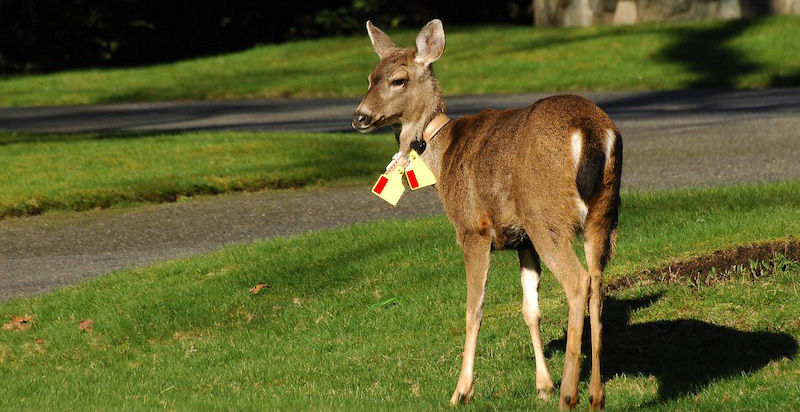
Do you remember seeing some of the deer in Oak Bay wearing some radio collars like this one? That was the first part of a two-part study on the population of deer in Oak Bay that we helped to facilitate and coordinate. The first part of the project was focused on giving an accurate measure of the population of urban deer in Oak Bay. This includes analyzing the movement of deer – do they have large home ranges? Do they wander or are they staying in a relatively small area?
We then helped to lobby for and coordinate the second phase of this study required by the Province of BC: to assess the effectiveness of using an immunocontraceptive (IC) vaccine as a non-lethal method of population control. With our input, the study team swapped out those radio collars and instead we use simple coloured collars with tags which help to keep track of which Does were treated with IC. All the deer the study team handled have ear tags to help us identify them.
This study is funded by the Province of British Columbia, the Municipality of Oak Bay, and donations from our supporters. The UVic based study team’s methods have undergone rigorous review and meet regulations put in place by the Canadian Council on Animal Care and BC Fish and Wildlife. This study to validate a new urban deer management approach (IC) also was endorsed by the BC SPCA.
Have you seen a deer with a collar? We have some FAQs about the collars that you might like to read.
VIDEO: Update on the Oak Bay Deer Project

Oak Bay Deer Project
The results are in once more! It seems that deer are honing in on areas with lush green vegetation and large-sized residential lots (as well as parks, green spaces, and golf courses). Results indicate that the conversion of the historic drought-resistant Garry oak ecosystems into the lush, landscaped urban environment of Oak Bay is likely supporting an urban Columbian black-tailed deer population than the native Garry oak ecosystem would. Read the peer-reviewed paper on this part of the research.
Additionally, after just one year of immunocontraception (IC: in the fall of 2019), the relative abundance of fawns decreased by nearly 60% in 2020. We’ve also found that the adult deer population has decreased by 31% by the fall of 2022. Data is still being analyzed, but we expect to have an update on the fawning rate soon. Hopefully, we’ll continue seeing reductions over the upcoming years.
If you’d like to read all of the Reports (Final or Interim) that were submitted to the District of Oak Bay and the Province, you can access them here:
District of Oak Bay’s Urban Deer Information
2025 Executive Summary Urban Deer Project Final Report
2025 Urban Deer Project Final Report
UWSS 2021 Interim Report on habitat use
UWSS 2021 Interim Report on fawning rates after immunocontraception
Esquimalt Deer Project
The 2019 Report is the second year of a 3 year monitoring project in Esquimalt. The methods used in Esquimalt aren’t as precise as the ones used within Oak Bay, but still allows a baseline monitoring of the deer population within the Township. Interestingly, there was no increase in the number of deer between this year and last year, indicating that deer population numbers are quite stable.
Esquimalt has now received the results of the immunocontraception program in their township and in neighbouring Oak Bay. There are hopes it will target its management efforts to best effect going forward.
To read more on the various Reports submitted to the Township of Esquimalt and the Province, you can access the reports here:


