Dec 10, 2015
Calling all local citizen scientists and wildlife photographers—a science-based project related to deer abundance in Oak Bay needs your help.
The Urban Wildlife Stewardship Society (UWSS) is doing a photo inventory of urban deer in Oak Bay. Similar to how killer whales can be identified through marks on and behind their dorsal fins, black-tailed deer can also be identified by scars, nicks, limps and other features unique to each individual.
The inventory will contribute to a better understanding of deer numbers in Oak Bay, and their movement patterns, says Bryan Gates, president of the UWSS and a former wildlife biologist with the BC government.
“No one knows how many deer live in Oak Bay. For some people, there are too many, for others there are not too many. That will never change,” says Gates. “Our photo inventory should give us some reliable estimates, and over time may show trends in numbers.”
For now, the emphasis for the photo inventory is on antlered bucks in the winter season. The size and shape of antlers varies from buck to buck, making it relatively easy to identify individual deer. But time is short—bucks typically lose their antlers early in the new year.
This is why photos taken from now to late January will be particularly useful. Good quality, digital photos can be taken by anyone. Head-on photos with ears spread are best. Send them by email to: [email protected]. It’s important that the date and exact location (approximate street address) be included with each submission.
These two photos of mature bucks in Oak Bay show how photography can help with deer identity for research, population estimates, seasonal and daily movement patterns, and even for mortality information.
Although the immediate focus is on the bucks, photos of female and yearling deer are also welcome. Missing or damaged ear tissue, is sometimes obvious. Most cuts, scars and tears, especially on the ears, will last and can provide useful identification features throughout the life of the animal.
“We invite everyone with an interest in urban wildlife, and especially deer, to get involved and help us gather this much-needed information,” says Gates. “With a broad set of easily identifiable individuals, repeated and frequent road-side counts of deer can contribute to a reliable estimate of the total population within the community. And that’s an essential first step to responsible management.”
Gates adds that photographers should take care not to approach deer too closely or startle them near a roadway.
Submitted photos will be be posted on the UWSS website.
The UWSS, formed in spring 2015, is a citizen-led, science-based organization committed to implementing effective, sustainable and non-lethal solutions to human-deer conflicts in Oak Bay, the CRD and other urban areas.

Nov 28, 2015
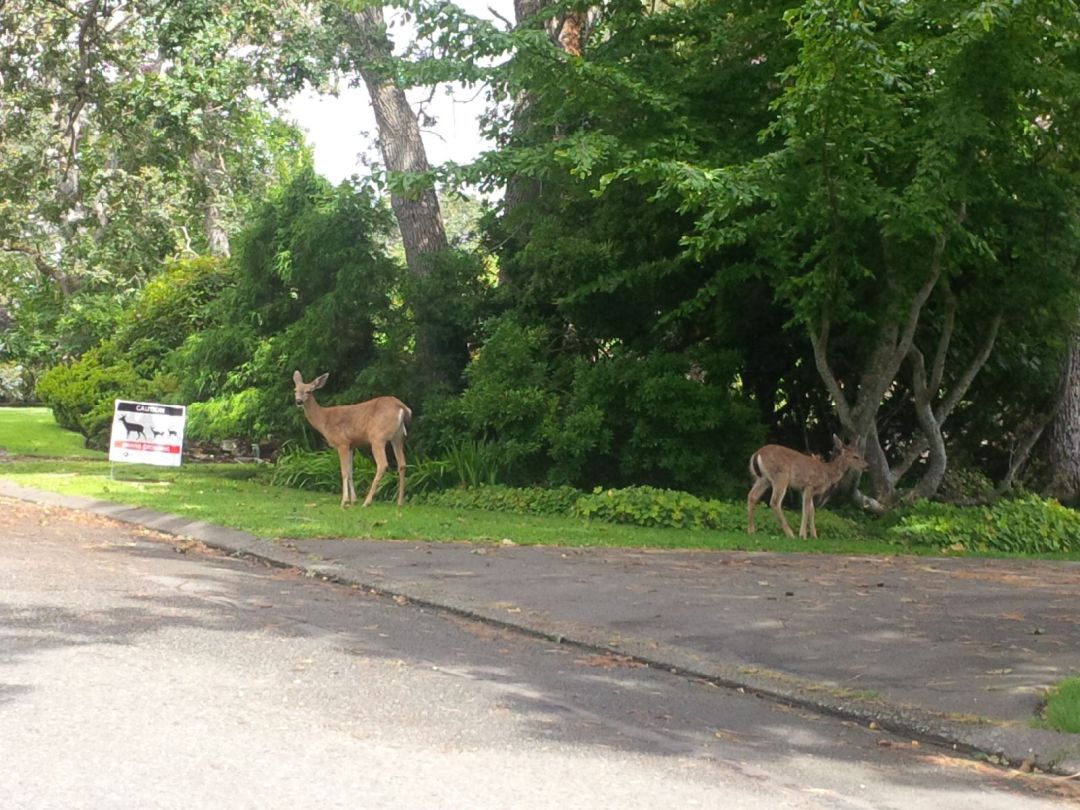
With a change in traffic patterns over the last few years, more frequent vehicle-deer accidents are beginning to occur on some roads in Maple Ridge. As a result, the Urban Wildlife Stewardship Society’s “Caution – Expect Deer” signs are being recommended as a model for small, colourful and eye-catching signage to help prevent such accidents in that community.
The UWSS has just received a new shipment of 200 signs for a total of 500, with requests continuing to come in from homeowners in Oak Bay and other municipalities. The signs alert drivers that they are in an area where deer are known to be, and where accidents may have occurred in the past.
Many residents request the signs out of concern that there will be an accident close to their home, due to the speed of drivers who do not realize they are driving in an area where deer frequently cross the road – often near deer habitat such as golf courses or areas that have nearby parkland such as Anderson Hill or Walbran Park.
Many residents who have signs on their property feel the “Caution” signs are making a difference – while not everyone takes heed, some drivers brake and slow down when they see a sign, or see several in close proximity to each other.
As an article in the Oak Bay News reports, deer are not the only casualties of dark and wet evenings and early mornings.
Remember to slow down, scan ahead and drive safely to avoid an accident – let’s keep our roads safe for humans and animals alike!
Oct 30, 2015
If you happen to be out in the misty early dawn or dusk hours over the next few days and see a vehicle or two being driven slowly and methodically throughout Oak Bay, you’re likely watching a deer count underway.
As the final step in the CRD involvement in the Oak Bay deer population reduction pilot project, a second deer count is occurring.
The CRD invited the Urban Wildlife Stewardship Society to participate in this count, and two of our board members, Bryan Gates (President) and Ralph Archibald (Director) are providing their extensive experience and expertise.
Bryan is a retired registered professional biologist with four decades of experience (he received his master’s on a study of Vancouver Island black tailed deer) and worked in environmental management and impact assessment with the BC government for 23 years.
Ralph is a former Assistant Deputy Minister of Environmental Stewardship for BC’s Ministry of Environment, with 40 years experience in the natural resource sector. They will be working with 10 others to begin to get an accurate as possible estimation of the number of deer in Oak Bay.
This count is different from the count completed in 2014 (and therefore cannot be considered a comparison) as it will cover all roads in Oak Bay and use a revised methodology developed by the CRD in consultation with the Ministry of Forests, Lands and Natural Resource Operations staff.
It is an index count which is a sample that can and should be repeated a number of times each year (at least quarterly) to determine trends in deer population size, show areas of relative concentrations of deer (where the greatest numbers are located) and year to year changes in numbers.
The CRD and province state that “regular counts are an important part of a deer management program”. They also state that deer management options include conflict reduction, vehicle-deer collision mitigation, public education and population reduction. These are all important components of the UWSS mandate that we are actively working on.
The UWSS continues to lobby for these initiatives and is working with the provincial and federal governments to obtain permits for the use of immuno-contraception as a humane, sustainable, economical and long lasting solution to population stabilization and reduction.
Oct 22, 2015
A reported cougar sighting in Oak Bay last Friday, October 16, has turned out to be false. As reported in the Times Colonist, a young girl “cropped a photo of a cougar that was shot and killed in Edmonton last year”, saying it was a photo of a cougar taken near Central Avenue and Monterey.
This photo incident clearly demonstrates the importance of science and evidence based information over anecdotes, speculation and urban myths.
As such, the Urban Wildlife Stewardship Society is glad to have been invited to participate in the CRD-led deer count that will take place in Oak Bay in late October and early November, as the final step in the Regional Deer Management Strategy.
Recognizing that in order to establish an accurate baseline of the deer population, along with capacity and movement patterns, there needs to be multiple counts over an extended period of time (at least quarterly), we look forward to conducting further deer counts and are exploring a variety of ways to conduct such counts in the most scientific, effective and accurate manner.
We will keep you informed!